




5G Essentials with Mobile Evolution
$2,595
Description
5G is the next-generation of mobile networks beyond the 4G LTE mobile networks existing today. The vision of 5G is becoming clearer and most experts say 5G will feature network speeds that are blazingly fast at 20 Gbps or higher and have low latency at mere milliseconds. The entire 5G approach takes advantage of containers, virtualization, SDN and NFV.
Mobile telephony has been around for a while. It is very possible that people entering this industry may lack sufficient grounding in how we got to where we are now. Many of the new standards predicate knowledge of previous architectures, greatly raising the barrier of entry for anyone new that is trying to enter the world of 5G. We start this course by reviewing how we got here and where 5G is taking us.
What You’ll Learn
This course covers just enough of the basics to understand how mobile telephony has changed over the past 27 years and where it is today. Students will cover the architectures of 2G to 4G networks, and 4G to 5G, learning why each new generation was needed, what changed, and what remained with each new generation. We will cover in detail the design motivation and underlying technology of 5G service-based architecture as well as new vocabulary terms. We will cover enough about 5G radio to understand the differences between 4G and 5G, and finally, take a look at the 5G core in action. Sample message flows of typical 5G processes are covered message by message.
The goal is to clearly see how 5G accomplishes its goals by observing how it actually works.
Module 1 - Introduction
You will gain exposure to the entire course contents in a very high-level course overview. You will also learn how to access additional information to stay current with 5G.
- 5G vs 4G features
- Mobility essentials:
- Visiting
- Home
- Roaming
- Control Plane
- User Plane
- 5G EN-DC
- 5G Stand Alone
- 5G Options
- LTE vs New Radio
- How to obtain additional 3GPP information about 5G.
Module 2 - New Radio
New Radio is the replacement for LTE. Learn the differences and similarities between NR and LTE here.
- Understanding why we need these three very different spectrums
- sub 1 gig
- mid band
- millimeter waves
- Priority Sectors in New Radio
- Beamforming
- Pilot Signals
- SU-MIMO vs MU-MIMO
- Massive mimo
- Densification
Module 3 - 5G EN-DC Core Architecture
You will study the core components of the 5G EN-DC network, also known as 5G Non-Stand Alone (5G NSA). Emphasis will be on the interoperability of architecture components and flow paths. Using network diagrams, you will plot the pathway of both user plane and control plane components.
- RAN architecture
- Evolved Packet Core in a 5G network
- Authentication center (AUC)
- Equipment identity register (EIR)
- Service Gateway (SGW)
- Packet Data Network Gateway (PGW)
- Mobility Management Entity (MME)
- 5G EN-DC Topology LAB Exercises
- Control Plane message pathways
- User Plane message pathways
Module 4 - 5G EN-DC Radio Access Network Architecture
You will extend the EN-DC core into the Radio Access network. You will diagram message flows within the 5G EN-DC network. You will learn practical applications for sub gig to millimeter wave RF spectrum.
- eNodeB
- Baseband Unit (BBU)
- Remote Radio Head (RRH)
- gNodeB
- Control Unit (CU)
- Distributed Unit (DU)
- Remote Unit (RU)
- Small Cell
- Front/mid haul architecture
- Common Public Radio Interface (CPRI)
- Centralized Radio Access Network (C-RAN)
- Cloud-RAN
- Bearer components in the E-UTRAN
- Bearer components in 5G EN-DC
- 5G EN-DC Call Flow Exercises
- 4G Access Stratum Call Flow
- 4G Non-Access Stratum Call Flow
- Authentication Essentials
- X2 handoff to gNodeB
- User Plane essentials
Module 5 - IMS Integration
You will learn how the IMS network is integrated into a 5G. While study of the IMS is a 5-day class itself, this section will review the role of the IMS, cover a few of the major components, and illustrate what components of the IMS change when integrating into a 5G network.
- The role of the IMS
- Protocols
- SIP, Diameter, DNS (enum), RTP
- IMS core Essentials
- P-CSCF
- I-CSCF
- S-CSCF
- SCC
- TAS
- HSS
- MRFC/MFRP
- PCRF
- IMS Call control and media paths
- 5G IMS integration
- IMS Exercise
- Call control path
- RTP packet path
- Lab exercise
- IMS call flow in a 5G network
Module 6 - 5G Stand Alone (SA)
Up to now you have been studying 5G EN-DC or Non-Stand Alone. Now you will learn the massive changes that arise with the implementation of 5G Stand alone. Many powerful features become possible only if 5G SA is deployed.
- 5G Services
- AMF and SMF control functions
- NSSF, AMF selection and slice access.
- NEF, AF and service exposure
- NRF and service discovery
- Database and DB frontend services
- UDR
- UDM
- AUSF
- PCF
- gNodeB, NG-AP, and the
- Comparing SA vs NSA (Stand Alone vs Non-Stand Alone)
- EN-DC and X2-C messaging
- IMS integration
- Slicing
Module 7 - 5G Stacks
A review of the Protocols in the 5G architecture. Many 4G protocols continue into 5G with a few very important additions that are described in this section. Security personnel in particular need to pay close attention to this section.
- Transport NAS and SMS over HTTP
- PDU Session
- N2 Interface
- NG Application Protocol (NGAP) TS 38.413
- Session Management Function
- N11 Interface
- Interworking with the EPC (TS 23.501 - 4.3.1.1)
- 5G Cloud Based Services
- Service operation naming
- Container-based Design of SBA (1 of 2)
- Container-based Design of SBA (2 of 2)
- HTTP Reverse Proxy
- HTTP/2
- JSON
Module 8 - 5G Mobility management
Mainly for the support of giga speeds and slicing, 5G mobility simplifies the tracking of UEs. This section describes how the UE location is tracked.
- Tracking Area (TA)
- Tracking Area List (TAL)
- Registration Area
- Timers
- Paging
- Session and Service Continuity (SSC) mode 1 and 2
- Session and Service Continuity (SSC) mode 3
- Priority Paging and QoS
- Paging Policy Differentiation (PPD)
- Network Triggered Service Request
- QoS Profile
- QoS Flow Marking
- Service Data Flow (SDF) Filter
- 5QI (QoS Flow ID)
- Lab Exercises
- Mobility withing a Registration Area (Tracking Area List)
- 5G paging Call flow
- 5G Registration
Module 9 - 5G Infrastructure
A study of where the 5G elements are commonly located within the network, paying close attention to geographic location and distances. The section answers the question, “where is all this stuff?”
- 5G Changes to the Access Layer
- 5G Network Location of elements
- 5G E2E Latency Requirements
Module 10 - The 5G Slice
Essentially, 5G reinvents the VPN, taking service delivery platforms to the hardware itself. While a common VPN is an overlay network, slicing implements the “VPN idea” directly on the 5G network itself. This opens up a level of capability, security, and mobility not realized by modern VPNs. This chapter will explore slicing architecture, applications, and capability.
- Understanding the motivation for Network Slicing
- The similarities that would make you think “VPN = Network Slice”
- The differences between VPN and Network slicing
- The slice buyer expectations and deliverables
- The slice provider Template (What to deliver)
- Why Slicing can deliver on an SLA contract
- Expectations on roaming to another service provider.
- Slice Architecture
- Network Slice Instance
- Slice Service Type
- Network Slice Subnets (RAN, Core, Transport)
- Network Slice Template
- Network Slice Assistance Information
- Information Object Class (TS-28541)
- Network Functions Virtualization
- Network Resource Model
- Solution Set
- Vertical and Horizontal Slices
- Core Slicing
- The Slice selection process
- Roaming with local breakout
- Roaming with remote breakout
- N4 Interface - Packet Forwarding Control Plane Protocol (PFCP)
- Service Function Chaining (SFC) Architecture RFC 7665
- Tunneling and the GTP Tunnel
- PDU Session Types
- RAN Slicing
- The 5G RAN overview
- QCI, Scheduling, Radio Layer
- Midhaul functional split
- 5G UE Radio Access Layers
- Limitations of CPRI
- Functional Split
- AAU, DU, and CU using the Option 2 Functional Split
- Cloud-RAN
- O-RAN architecture
- OpenRAN
- vRAN
Module 11 - Using Unlicensed Spectrum
- Interoperability with Wi-Fi
- LTE-U
- LAA
- Listen Before Talk (LBT)
- MulteFire
- New Radio Unlicensed (NR-U)
- 5G Radio Frame Format
- SAS New Radio Unlicensed (NR-U)
- CBRS Summary CBRS Architecture Synchronous NR-U
- Requirements for Commercial Operation in 3550-3700 MHz CBRS Band Locating
Module 12 - US Unlicensed Spectrum in the Mid-band
- 3100-3450 & 3450-3550
- CBRS Band - Three Tier Approach
- C-Band
- U Nil Bands (5 GHz)
- UNI Bands (6 GHz)
- 7-8 GHz
Module 13 - Multi-Operator Core Networks (MOCN)
- Introduction to MOCN
- Active Carrier Sharing MOCN Call Flow
Module 14 - Multi-Access Edge Computing
- 8 Network Function Virtualization Components
- Why Two Bridges?
- Simple NFV (Network Function Virtualization) Example
- MEC Reference Architecture in a NFV Environment
- Mobile Edge Computing to Multi-access Edge Computing
Module 15 - EU and PDU Session State
This section is an essential review prior to studying actual call flows. Ultimately, call flow impacts mobility and session state. By understanding the goal of managing mobility and session state, understanding call flow is made clearer.
- 5GMM main states in the UE
- 5GMM main states in the network
- UE PDU Session States
- SMF PDU Session States
Module 16 - 5G Flow Diagrams
- LTE eNB - 5G gNB dual connectivity (EN-DC)
- LTE eNB - 5G gNB dual connectivity (EN-DC) with EPC flow
- 5G Standalone Access: Registration Procedure
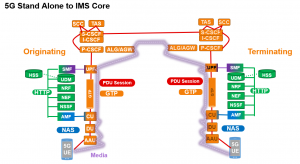
This course will cover 5G IMS access, describing all the components you see below.
When it comes to IMS architecture, IMS stays as it is. The exception is HSS which now can be co-located or implemented as a part of the UDM. However, the functionality of HSS should remain standalone.
- VoLTE and the IMS (not mandatory)
- Software Defined Networking & Network Function Virtualization (not mandatory)
Anyone who needs a high-level overview of complete 5G rollout, Network Engineers, Infrastructure Engineers, Management, Planners and Project Managers.